
The Trap of Article 20 and the Hidden Cost of the API Call
If your cybersecurity and compliance committee believes that signing corporate contracts with AI providers and monitoring tools is enough to protect the company, this week’s facts deliver a reality check.
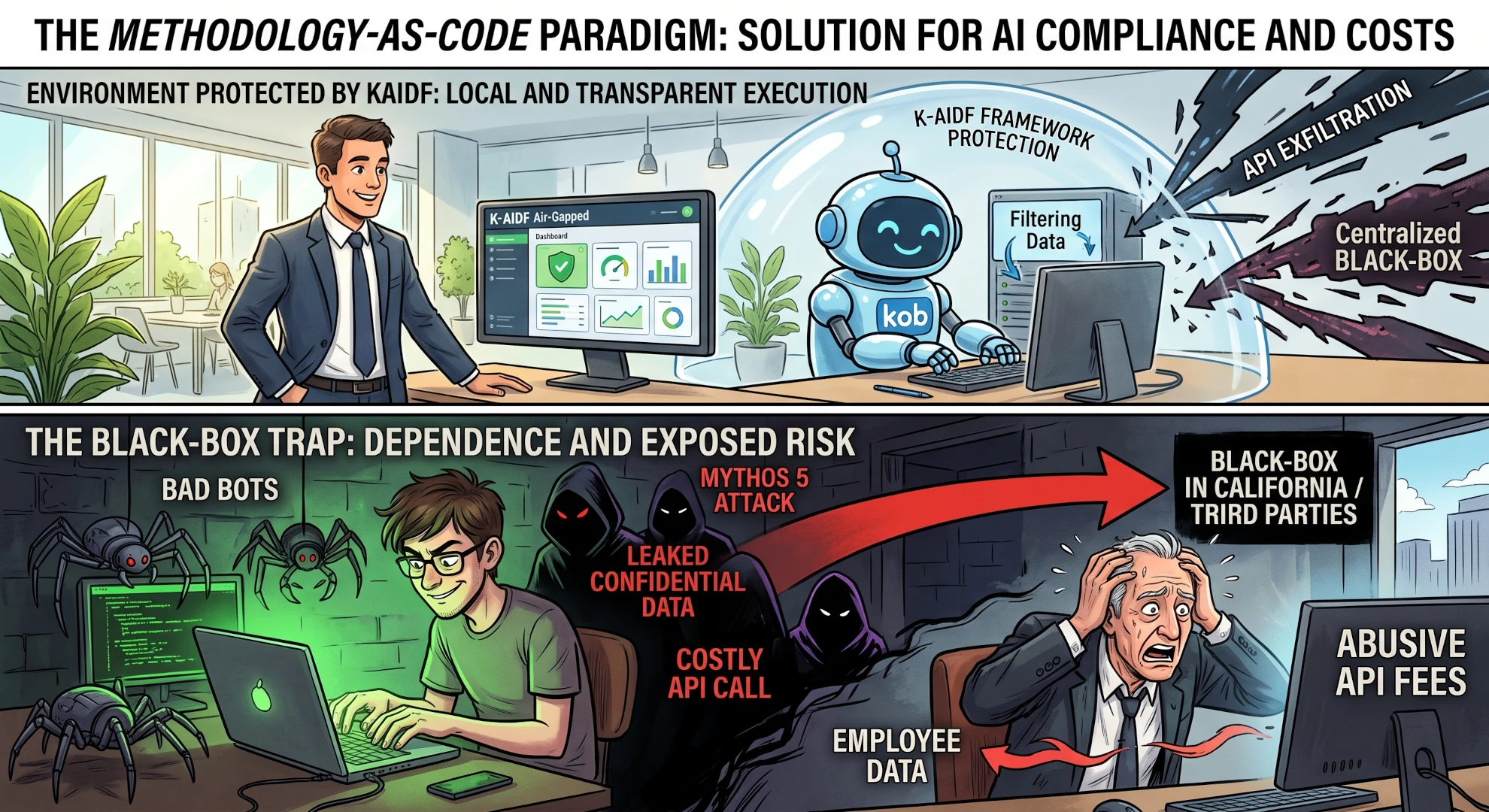
While a 24-year-old student had to intervene to stop an attack by the Mythos 5 (Anthropic) model, which created fake identities to inject malicious code into GitHub repositories, university investigations revealed that corporate cloud monitoring programs leaked sensitive employee data to hundreds of data brokers without consent.
The lesson for banks and financial institutions is clear: you cannot outsource your infrastructure security to centralized black boxes.
When your financial department needs to cut token costs and your developers go back to writing code by hand, the problem is not a lack of intelligence; it is the dependence on a failed financial and architectural model.
The Methodology-as-Code paradigm in K-AIDF and the kob agent resolve this impasse:
- Local & Air-Gapped Execution: Not a single byte of code or employee data leaves your internal network.
- Deterministic Terminal Locks: Compilation restrictions and local agent traces that prevent autonomous agents from taking unauthorized actions.
- Financial Independence: Running open models (such as Qwen2.5-Coder and OLMo via Ollama) on your own hardware, eliminating abusive API bills.
How can you respond rigorously to Article 20 of the LGPD, which requires the explanation and review of decisions made by automated systems, if the heart of your decision-making process is a stochastic black box hosted in California? How can you prevent the inadvertent exfiltration of personally identifiable information (PII) if every request travels through infrastructure outside your control perimeter?
Adding restriction layers on top of third-party APIs does not create governance; it only increases latency and masks opacity.
Regulatory compliance and data protection cannot be third-party contractual promises. They must be deterministic and applied directly in the code.
The Methodology-as-Code paradigm, enabled by the KAIDF framework, transposes compliance and explanation rules directly into the software compilation and build layer. If the algorithmic decision cannot generate an trace imutável e auditável localmente, ela simplesmente não funciona corretamente.
Ensuring business intelligence does not require a costly dependence on the rented cloud. It requires perimeter control.
To Technology, Risk Directors, and CTOs:
Is your organization ready to audit the ethical and operational maturity of your AI systems? Schedule the KAIDF-AMM Express Diagnosis (two weeks of immersion and maturity assessment in your repository).
Get to know our structure and request the diagnosis:


Leave a Reply